
Not too long ago I had a hip replacement. Now, that’s a pretty common surgery these days – common enough that in some circumstances it’s considered to be an outpatient procedure. Imagine that, you wake up one morning, go to a surgical center, they put your ass under (and hopefully the rest of you), then cut you open and essentially detach your fucking leg from your body, hollow the bone out, use a medical sledgehammer to pound a steel shillelagh into it, then sew you back up. None of that is too much of an exaggeration, by the way. That’s more or less the entirety of the fucking procedure.
Understandably, I was a little nervous about this.
Being nervous about a medical procedure means there are a few things you can do to address those fears. One, and one that I have found actually helps the most, is to seek out more information and understanding about the procedure. Typically I have found that what we fear the most is the unexplained and unknown, and once you dispel the shroud of ignorance about something you don’t fear it – or at least fear it less than you did before. The best way to do this would be, of course, to consult the medical professional that is going to be performing the operation. I, however, had a better source of information than any dumb old doctor!
I had the r/hipreplacement subreddit.
In perusing the subreddit, I discovered a new fear. See, there were a number of posts on there about people who had woken up during the surgery, having received a spinal and therefore being completely numb from the nips down, and heard the surgeon doing all of the things listed above to them. They couldn’t feel anything, but they could hear it. Unable to speak or move, but completely cognizant of the situation and what was happening to them.
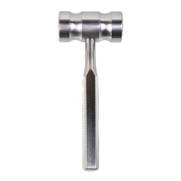
By the way, just for funsies, here’s a picture of a surgical mallet that is used in this shit. Because you absolutely know I had to look that up.
So that was a brand new fear unlocked. One that I now had lingering in the back of my mind and one that I shared with a friend of mine who came by to stay with us and help out around the house while I was recovering. I told him about this new and interesting terror that was now lurking in the back of my mind and, in an attempt to comfort me, he said:
“You don’t need to worry about that, man. We’re big guys! They’re much more likely to give us too much and kill us than they are to give us too little and have you wake up!”
So now I had two new fears.
***
You know that old saying “Who shaves the barber?” Well, here’s a question for you – who writes the will for the lawyer? The obvious answer to both is “They just fucking do it themselves.” Were I a smarter man, I would have a last will and testament in place well before any surgical procedure would even have been a blip on the horizon of my life. But much like a bearded barber, I would imagine in a hipster area of Brooklyn or something, I found myself bereft of estate planning documents that had been completed. Sure, I had drawn up a will before – for other people. It was a common part of my work when I was in private practice. But I had never really sat down and thought about the fact that I, one day, would also need to have everything prepared when I eventually kicked the bucket.
So let’s talk about that today: What happens when someone dies without a will – at least on the legal side of things. But before we do, a disclaimer: I am a lawyer, but I most fucking definitely am not your lawyer. What we’re doing here today is a discussion of general legal principles and information. ALL of these things are general discussions, which is important because law – especially in this area – is not general in nature. It’s actually pretty goddamn jurisdiction specific. So you can’t take anything here as legal advice – I don’t know where you are and I don’t know the specific law in your jurisdiction. You know what you need to do if you need more information on this shit? You need to track down a lawyer who is licensed to practice in your jurisdiction and ask them all of the questions you desire to clarify these principles and the specific laws that apply to you. Nothing here is legal advice, there’s no attorney-client relationship, and you really, really, really should not be taking what some dude on the internet that you’ve never met says as the authority in these matters.
We all on the same page there? Good. Let’s begin.
WHAT HAPPENS WHEN YOU DIE WITHOUT A WILL?
Let’s say you’re like me and you suck at both planning and considering your own mortality when it isn’t three in the morning in a darkened bedroom as you stare at the ceiling unable to sleep while your brain reminds you that one day all you are and have ever been or will be will simply cease to exist. I’m a married man though so even without a will all of my shit would go immediately to my spouse. That’s a fair assumption, and a common belief that you run into with folks constantly. It’s also not true – at least not in my state.
See, when you die without a will the state chooses who gets your shit. This is done in the form of a statute laying out the line of Intestate Succession – or breaking it out of “fancy lawyer words” and into common tongue, “the order of people who get your shit when you die without a will.” It is, of course, a common belief that once you are married the person that would get all of your shit would be your spouse. They are, after all, the person with the right to do a lot of things. In some states, like Kentucky (with one real exception), that’s a pretty fair assumption to make. But in other states – including mine – that’s not entirely accurate. Your spouse is, certainly, an heir of your intestate estate, but they are not the heir of your intestate estate and other people may have a claim on your assets in addition to them. Let’s take a look at the applicable law here in Pennsylvania:
The intestate share of a decedent’s surviving spouse is:
(1) If there is no surviving issue or parent of the decedent, the entire intestate estate.
(2) If there is no surviving issue of the decedent but he is survived by a parent or parents, the first $30,000 plus one-half of the balance of the intestate estate. Notwithstanding the foregoing, in the case of a decedent who died as a result of the terrorist attacks of September 11, 2001, a surviving spouse shall be entitled to 100% of any compensation award paid pursuant to the Air Transportation Safety and System Stabilization Act (Public Law 107-42, 115 Stat. 230).
(3) If there are surviving issue of the decedent all of whom are issue of the surviving spouse also, the first $30,000 plus one-half of the balance of the intestate estate.
(4) If there are surviving issue of the decedent one or more of whom are not issue of the surviving spouse, one-half of the intestate estate.
(5) In case of partial intestacy any property received by the surviving spouse under the will shall satisfy pro tanto the $30,000 allowance under paragraphs (2) and (3).
– 20 Pa.C.S. § 2102
So again, going from “oh my god I took out how much in student loan debt to understand this” to English, what that says is if you die without a will and your parents are dead and you have no kids, then of course your spouse is the heir who gets everything. HOWEVER if you die without kids and either of your parents are still alive, then your spouse is entitled to the first $30,000 of value from your estate and the remaining estate is split 50/50 with your parents. So say your estate, after debts are paid, is $500,000. Your spouse would get $30,000 of it, then the remaining $470,000 would be split in half and distributed between them and your parents accordingly. When you toss kids into the mix it gets even weirder to figure out. If all the kids are yours and your spouse’s, then the inheritance is the same as above except the kids step into the place of your parents. BUT if one of the kids isn’t a kid from your relationship with your spouse, then your spouse loses the entitlement to the first $30,000 and they only get one-half of the estate.
So if your kids or parents outlive you, and your spouse does as well, all of the sudden those assets you thought would go to your spouse don’t go just to your spouse. There are, of course, obvious issues with this for some people who may have less-than-stellar relationships with their parents or kids that may not take care of your partner after your death and leave them in a bad place for whatever reason. In such a situation the benefits of a having a valid will in place are pretty obvious.
What I’m getting at here is when you assume that your state makes sure everything goes to your spouse even if you don’t have a will, you’re really rolling the dice on that being the case unless you first take a look at the applicable Intestate Succession statute for that state.
MY FAMILY LOVES EACH OTHER AND WE HAVE GOOD RELATIONSHIPS AND THEY WOULD JUST GIVE EVERYTHING TO MY SPOUSE ANYHOW BECAUSE THAT’S HOW GOOD THEY ARE.
Well la-dee-dah, look at you Mr./Ms./Mx. Stable Family Life. Aren’t you just a fucking Hallmark movie. I bet none of your Thanksgiving dinners ever end awkwardly explaining how a carving knife ended up in Uncle Joey’s foot in the local ER/Emergency Vet. Still, your happy little family isn’t going to be exempt from issues just because they all want to honor your last wishes that you for some reason never wrote down and instead only expressed vocally during the annual Holiday Group Hug.
Let’s use an example – and one that isn’t far-fetched because I saw it happen more than once. Say Dad never wrote a will and he dies. He has a pretty sizeable estate and he has repeatedly said that he wants everything to go to Mom. You and your three siblings, all of whom are self-sustaining and don’t need the money, are 100% behind Dad’s decision-making on this one and agree that everything goes to Mom. However, there is no will to this effect, and before Dad can write one up he dies.
Now, based on what we read above in Pennsylvania this would mean that Mom gets the first $30,000 then ½ of the remaining money – let’s say her ½ comes to $750,000. Remember, this is for the ease of doing our math and hyperbolic to stress the importance of shit…but also it’s not out of the realm of possibility for someone with over $1.5 million to just never write a will. Stranger things have happened. Anyhow, you and your siblings are now each entitled to 1/3 of the remaining ½ share of the estate, or $250,000 each. And you all have no intention of keeping it because Dad wanted it all to go to Mom. So you go to a lawyer to help open the estate to administer it, and that’s when the lawyer sucks on their bottom teeth, makes an exasperated noise, and starts to explain what you have to do.
IT’S NOT JUST GIVING THE MONEY TO MOM, IS IT?
Nope. It most definitely – at least in Pennsylvania – not just giving the money to Mom.
There is a process by which someone can say “Hey, in this case I want you to act like I died before the actual dead person.” This is called “disclaiming” or “renouncing” the inheritance. The terms are used interchangeably, so you can use either, but I’m going to go with “renounce” because it sounds more forceful: “I RENOUNCE you, payout from my father’s 401k!”
Anyhow, let’s stick with Pennsylvania, which is the state I know the best. First, if you want to renounce your right to claim from your parent’s (or child’s) estate in favor of someone else – well, you can’t. As in you can’t renounce in favor of a specific person. What you are doing when you renounce is saying “I want you to act like I died before every other potential heir” to the administrator of the estate and the courts overseeing it. So say you decide to renounce, you do so, and your siblings decide not to renounce because they never forgave you for that one time in the fourth grade Dad took you to go get ice cream and they didn’t come along or something. That means you didn’t just give $250,000 to Mom, you actually put $250,000 back into the estate to be divided amongst the surviving heirs. And since Mom’s share is capped at $30k + ½ of the remaining estate, Mom doesn’t actually get more money because the overall size of the estate hasn’t changed. Instead your siblings are now dividing the remaining ½ between just the two of them instead of the three of you, so their shares now increase $125k per person.
So if there is more than one person renouncing, you need to make sure it’s being done all at once. Likely by all of the people renouncing delivering the renunciation documents to the attorney for the estate to hold in escrow until all of them are received, then filed at once. And of course there are renunciation documents – in Pennsylvania, for example, a renunciation must be in writing, signed by the person renouncing their inheritance right, and describe the interest that is being disclaimed as well as being delivered to the officer of the Register of Wills and filed there. Other states, of course, may have different requirements for a valid renunciation be they more or less strict and involved. Also, while there is no time limit on making such renunciation in Pennsylvania, other states do have such a time limit. For instance, New York states than a renunciation must take place with nine months of the death of the person you’re renouncing the inheritance from or you’re fucking stuck with it.
So if you live in New York or a jurisdiction with a similar deadline and wait 10 months then that collection of creepy porcelain dolls Mom willed to you, and the curses they inherently hold, are yours baby.
NINE MONTHS? THAT’S A WEIRD TIME.
I mean yes and no. But the answer to why states may adopt a strict nine month deadline is obvious once you remember that Benjamin Franklin quote: “In this world nothing can be said to be certain, except death and taxes.”
Internal Revenue Code 25.2518-1 governs when a disclaimer is effective in order to avoid related taxes. If the disclaimer is not made within the nine month period following the death, then you end up with a situation where there may be taxes owed in relation to the inheritance.
Yes, I know, the Federal estate tax is something most people will absolutely never hit given that it only kicks in at $15,000,000 (which, by the way, is pretty fucking ridiculous. Did you know that they tripled the amount of that exclusion in the last 15 years? Seriously, go look, back in 2011 it was $5,000,000. Jesus). You hear a lot about that shit in the campaign years: “Oh death taxes! They’re gonna tax your inheritance!” Let’s be clear, your inheritance only gets taxed federally once the estate exceeds the $15,000,000 exclusion – something the vast majority of Americans will never have to worry about. I have my opinions on this topic, but I hope you realize that shit is just a scare tactic used to make it sound like the IRS is coming after the value of Granny’s Precious Moments figurines that she said she liked one time and then everyone started getting her them every goddamn Christmas.
But in the situation where you fail to disclaim your share of a $15,000,000 estate prior to the nine months, yeah, there could be tax consequences.
Likewise, it could have an effect on your gift taxes. Say you disclaim on month ten. Maybe your state, like Pennsylvania, allows you to do that, maybe it doesn’t. However under Federal law you didn’t disclaim in the nine month period, so the money you allowed to be passed to others is now treated as a gift from you to them for tax purposes. Now, again, the Federal gift tax has a hefty limit – you can transfer up to $15,000,000 to people in your lifetime before you gotta start worrying about tax implications. BUT if the gift is more than $19,000, now you gotta start filling out forms and having shit count against the tax limit exclusion for gifts. Just a pain in the ass, really.
But still – you aren’t gonna be paying Federal estate or gift taxes until there’s a shit ton of money at play is the long and short.
…Notice I said “Federal?”
About 12 states out there have their own estate tax, with some limits as low as $1,000,000. But, more importantly for this discussion, is the fact six states – including Pennsylvania – have a separate inheritance tax. Those actually apply more strictly, and directly impact you. An inheritance tax, while typically paid out of the estate, is directly chargeable against and reduces your share of the estate. So yes, you may actually end up owing money on your inheritance. Luckily Pennsylvania has no time limit to renounce your right to inherit!
Except it does for tax purposes. You can renounce at any time (so long as you haven’t accepted the inheritance or benefits of it)…but if you do it after nine months from death, you still owe the Keystone State its share of the blood here.
Not only that, but you know what is taxable? An inherited distribution from a retirement plan owned by the decedent but which you are not eligible to roll over or receive tax free.
SO WE DISCLAIM WITHIN NINE MONTHS IN A WAY WHERE WE ALL TRUST EACH OTHER AND THERE’S NO REAL TAX ISSUES, MOM GETS ALL THE MONEY, PROBLEM SOLVED. WHY DOES THAT MEAN INTESTATE ISSUES ARE ACTUAL ISSUES?
Okay first I want you to stop and realize how much money has probably, at this point in the estate administration, been paid to a lawyer to help you all arrange and untangle this mess. All of that is going to come out of the estate, assuming there’s enough there for it, and accordingly decreasing Mom’s money while guys like me deposit our fee checks. Given that a cheap will for a smallish estate that’s uncomplicated will run anywhere from $500-$1,500 from a ham and egger, you’ve already gotten onto the bad side of a risk-benefit analysis.
Second, aside from trust issues and taxes, there are still other issues that may arise. For instance, are you or anyone you care for on government assistance? Do you possibly receive disability or some benefit that you will depend on for longer than the inheritance would benefit you? Do you want to fucking lose it?
A renunciation of a right to receive from the estate is a wonderful thing to make sure Mom is cared for and avoid the taxes. But the necessity of doing so can certainly fuck up your eligibility for some benefits such as Medicaid. While the rules on what programs it could fuck up are once again going to vary from state to state, the idea is that when you have a right to receive something that would make it so you don’t have to rely on the government you are required to take it, use it, and then reapply once it is exhausted. It sounds simple but anyone who has ever applied for benefits and jumped through those hoops knows what a fucking nightmare that can be…especially when it renders you ineligible for a period of time on the assumption you received that money when you absolutely fucking didn’t.
Again, something you’d need to speak to an attorney in your specific state about.
WHAT DOES A WILL DO TO FIX THIS?
Well, a will allows the dead guy to determine what happens to his money. First, it removes the statute of intestacy completely out of the picture so long as the will is valid and covers all of the assets. So you don’t have to worry about a complicated situation where you need to trust everyone in good faith when money is involved or worry about taxes or benefits. It lets good old Dad, additionally, consider the positions of the people involved. For instance, if your brother is special needs and on Medicaid, Dad can arrange for a trust for his care rather than running the risk of him being rendered ineligible. It lets there be some idea of how things SHOULD go rather than simply trusting it to the government.
In other words, it’s just generally a good idea.
And I know, I know – you’re saying “Of course you’d say that Boozy, you want everyone to pay for a will!” However, I’m not in private practice. I don’t get shit from you getting a will or not – I just like talking about this shit. Plus, to be honest, most people don’t need a Rockefeller Will to dispose of their assets. Most people, especially married folk, just need some simple estate planning in the form of what we call a reciprocal will.
What does that mean?
Well shit. If I told you that I’d have nothing to write about next time, would I?
